| Trace
fossils |
||
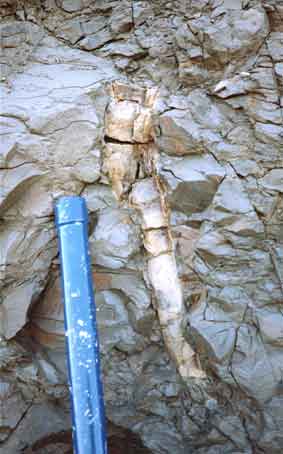
| The trace fossils found on Sheppey are largely confined to the surface of the cement stones which form bands at different levels ( see Chris King's diagram ). These traces are probably burrows created by shrimps and worms. Lobster burrows, usually without a lobster in place are the other trace fossil and can be seen either in situ washing out on the foreshore, or in the cliff. They can be as long as three feet long and indicate the soft nature of the sedimentary seabed in Eocene times. | ||
|
||
| Lobster
burrow in situ at Warden point-band D. Vertical cylindrical phosphatic
nodule with 'slickensided' surfaces due to differential compaction,
formed around a vertical lobster burrow. |
||
| Trace
fossils on the surface of Septarian Nodules |
||
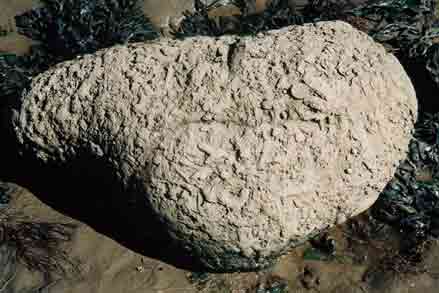
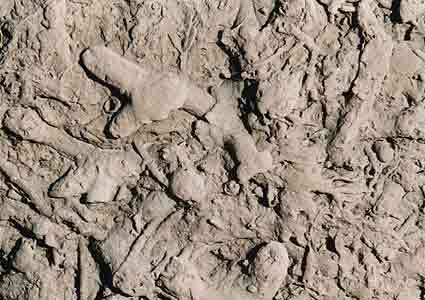
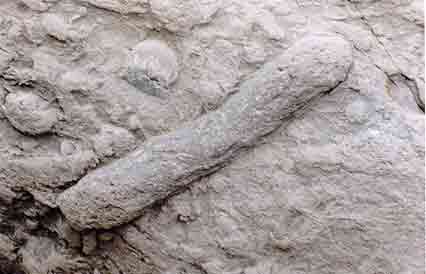
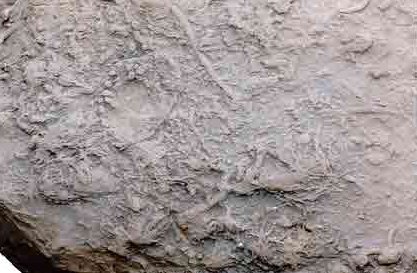
| The London Clay at Sheppey is extensively bioturbated. Due to the differential cementation of the burrow fills, extensive etching due to weathering, the nodules show a complex network of interlacing burrows. The pattern of bioturbation seen on them can reasonably be regarded as representative of the beds in which they occur. | ||
 |
 |
 |
| Cement
stone on the foreshore covered in trace fossils. The images below show
the bioturbation in more detail. |
||
| Palaeophycus/?Thalassinoides, flattened cylindrical burrows, usually 5-25 mm in diameter. Straight or curved, surface rather featureless. Y shaped branching sometimes observed. Can often form a complex interlacing mass. They may be interpreted as dwelling or crawling traces of crustaceans. | ||
 |
 |
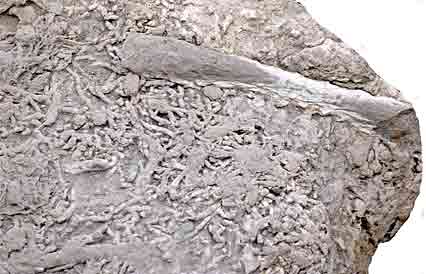 |
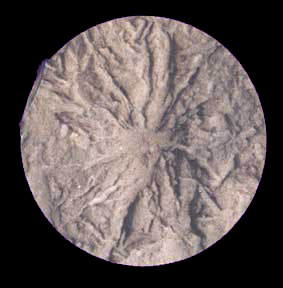
| Glockeria, comprise thin branching ridges radiating irregularly from a central area. Typically 50-80mm dia, rarely occur individually but generally as complex intermeshed mass (as in the image above). Interpreted as feeding burrow. | Palaeophycus and Chondrites. Paleophyeus are flattened burrows from 5mm to 25mm in diameter. They are unbranched, straight or curved. Chondrites are 0.3to 0.6.. diameter, repeatedly dichotomously branching burrows. Abundant, often filling spaces between larger burrows. Has been interpreted as feeding burrow of a sipunculoid worm | |
 |
 |
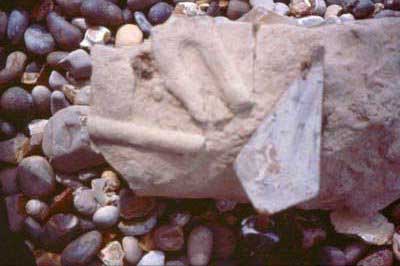 |
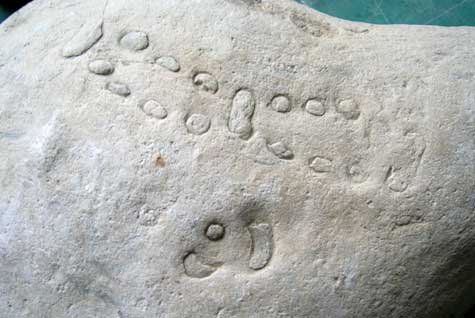
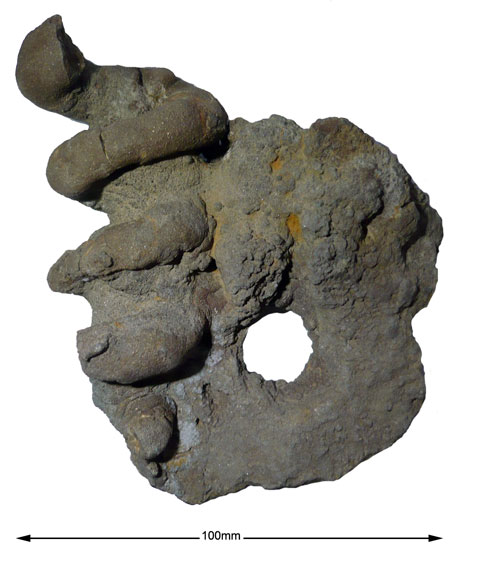
| This is a rather rare trace fossil called Helicodromites mobilis. It is a horizontal helical spiral. As can be seen when sectioned, the spiral produced off-set circular sections are clearly visible in this example. That section is not central so three of the spiral sections are cut longitudinally. H. mobilis occurs in deep-water muds, but also in shallower settings as long as the seafloor is quiet and muddy. My thanks to Richard Bromley for his help in identifyingthe left hand specimen. The right hand specimen is a solid pyrite cast and as far as I know is unique. Found by Danny Hogben. (Beach collected) | Rhyzocoralium, a U shaped trace fossil photographed by Diana Clements where found. | |


|
||